
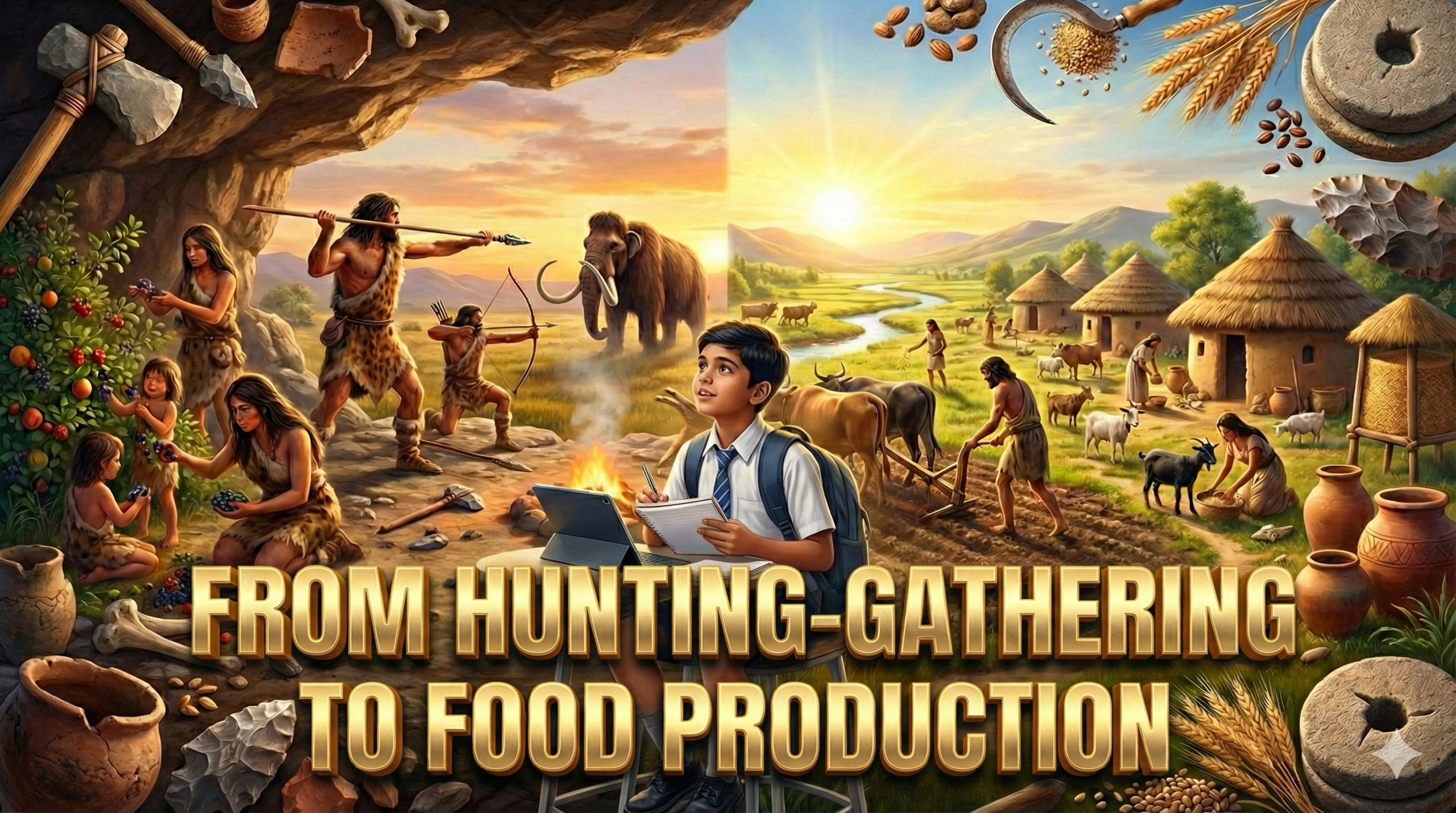


Class 6 History – Chapter 2: From Hunting-Gathering to Growing Food
(Comprehensive Detailed UPSC/IAS Guide)
1. Chapter Introduction: The Greatest Revolution in Human History
Hello friends. This chapter is about that decisive turning point in human civilization which historian Gordon Childe called the “Neolithic Revolution”. It is the story of how humans learned to control nature instead of remaining dependent on it (Parasitic nature). We will learn how a hunter human, who ran after food, became a farmer and laid the foundation of civilizations. For UPSC, this chapter is the key to understanding the ‘Evolution of Culture’.
2. Hunter-Gatherers: Life and Struggle
The people who lived in this subcontinent 2 million years ago are called Hunter-Gatherers. This name is derived from the way they arranged their food.
- Food: They hunted wild animals, caught fish and birds, and gathered fruits, roots, nuts, seeds, leaves, stalks, and eggs from the forest.
- Alertness: To hunt, they had to run faster than animals and be very alert. To gather food from plants, it was essential to know which fruits were poisonous and which were edible.
4 Scientific Reasons for Nomadic Life (UPSC Mains Point):
- Resource Exhaustion: If they stayed at one place for a long time, they would have eaten up all the available plant and animal resources.
- Animal Migration: Animals moved in search of grass and prey, so hunters had to follow their movements.
- Seasonal Cycle: Plants and trees bear fruit in different seasons. So, people may have moved from season to season in search of different kinds of plants.
- Water Scarcity: People living on the banks of seasonal rivers and lakes would have had to go in search of water during the dry seasons.
3. Stone Tools and Making Techniques (Technology of Stone Age)
Archaeologists have found tools of stone, wood, and bone, which reflect the ‘Technology’ of that time.
Uses of Tools:
- To cut meat and bone.
- To scrape bark (from trees) and hides (animal skins).
- To chop fruit and roots.
- Some tools were attached to handles of bone or wood, to make spears and arrows for hunting.
- To chop wood (for firewood and making huts).
Two Techniques of Making Stone Tools:
Early humans made tools by striking stone against stone.
- Stone on Stone: The pebble from which the tool was to be made (core) was held in one hand. Another stone (hammer) was used to strike off flakes from the first.
- Pressure Flaking: Here the core was placed on a firm surface. The hammer stone was used on a piece of bone or stone that was placed on the core, to remove flakes that could be shaped into tools.
Classification of Stone Age
- Palaeolithic (Old Stone Age): 2 million years ago to 12,000 years ago. Divided into Lower, Middle, and Upper Palaeolithic. This covers 99% of human history.
- Mesolithic (Middle Stone Age): 12,000 to 10,000 years ago. Identification: Tiny stone tools called ‘Microliths’.
- Neolithic (New Stone Age): From about 10,000 years ago. Identification: Agriculture, domestication, and polished tools.
4. Places to Live: Industry and Habitation (Sites Classification)
Archaeologists classify sites based on their usage:
- Factory Sites: Places where good quality stone was available and people made tools. Chips of waste stone are found here.
- Habitation-cum-factory Sites: Sometimes, people lived in these factory sites for a longer spell of time. Both evidence of living (ash, food remains) and tool making are found here.
- Habitation Sites: Such as caves and rock shelters (Bhimbetka). People chose these natural caves because they provided shelter from rain, heat, and wind. These are often found near river banks like the Narmada valley.
Case Study: Hunsgi – Karnataka
This is an important Palaeolithic site.
- A number of early Palaeolithic sites were found here. Some were probably habitation-cum-factory sites.
- Important Fact: Most tools were made from Limestone, which was locally available.
5. Fire and Changing Climate
Traces of ash found in Kurnool Caves suggest that people were familiar with the use of fire. It was a revolutionary discovery that turned night into day (light), made food digestible (cooking), and provided protection (scaring away animals).
Climate Change 12,000 Years Ago:
There were major changes in the climate of the world, with a shift to relatively warm conditions. The consequences were far-reaching:
- Grasslands: Warmth led to the development of grasslands.
- Increase in Herbivores: This led to an increase in the number of deer, antelope, goat, sheep, and cattle (animals that survived on grass).
- Human Observation: People started thinking about herding and rearing these animals after learning about their food habits and breeding seasons.
- Grain Bearing Grasses: Grain bearing grasses like wheat, barley, and rice grew naturally in different parts of the subcontinent. Men, women, and children collected these grains as food and learnt where they grew.
6. The Process of Domestication
Agriculture and herding were not a one-day event; it was a process spanning thousands of years. This is called ‘Domestication’.
Science of Selection:
- Plants: People selected plants that yielded large-size grain, and had strong stalks, capable of bearing the weight of the ripe grain. Seeds were preserved to be sown to ensure new plants had the same qualities.
- Animals: Only those animals were selected for breeding that were relatively gentle. This is why the teeth and horns of wild animals (like wild boar) are much larger than those of domesticated animals.
- Order: The first animal to be tamed was the wild ancestor of the Dog. Later, sheep and goat. The earliest plants to be domesticated were Wheat and Barley.
7. A New Way of Life (Storage & Stability)
Farming taught humans to ‘think about the future’ and ‘plan’.
- Storage: Grain had to be stored for both food and seed. So people began:
- Making large clay pots (Pottery).
- Weaving baskets.
- Digging pits into the ground.
- Animals: ‘Store’ of Food: Animals multiply naturally. If looked after carefully, they provide milk (important food) and meat whenever required. Thus, animals were a ‘store of food’.
8. Important Sites and Evidence Found (UPSC Prelims Special)
The table below is extremely important for “Match the Following” questions in UPSC Prelims:
| Site (Location) | Grain and Bones (Evidence) |
|---|---|
| Mehrgarh (Pakistan) | Wheat, Barley, Sheep, Goat, Cattle |
| Koldihwa (Uttar Pradesh) | Rice, Fragmentary Animal Bones |
| Mahagara (Uttar Pradesh) | Rice, Cattle (Hoof marks on clay surface) |
| Gufkral (Kashmir) | Wheat and Lentil |
| Burzahom (Kashmir) | Wheat and Lentil, Dog, Cattle, Sheep, Goat, Buffalo |
| Chirand (Bihar) | Wheat, Green Gram, Barley, Buffalo, Ox |
| Hallur (Andhra/Karnataka) | Millet, Cattle, Sheep, Goat, Pig |
| Paiyampalli (Tamil Nadu) | Black Gram, Millet, Cattle, Sheep, Pig |
9. Evidence of Settled Life (Archaeological Evidence)
(A) Mehrgarh (Pakistan) – The Earliest Village
Located near the Bolan Pass. Mehrgarh is probably one of the places where women and men learnt to grow barley and wheat, and rear sheep and goats for the first time in this area.
- Architecture: Remains of square or rectangular houses have been found. Each house had 4 or more compartments, some of which may have been used for storage.
- Burial Rites: People believed in life after death. Dead persons were buried with distinctive pots. In one instance, the dead person was buried with goats (probably meant to serve as food in the next world).
(B) Burzahom (Kashmir) – Pit-houses
People built Pit-houses, which were dug into the ground.
- These had steps leading into them. They provided shelter in cold weather.
- Hearths: Archaeologists have found cooking hearths both inside and outside the huts. This suggests that depending on the weather, people could cook food either indoors or outdoors.
(C) Daojali Hading (Assam) – Evidence from North-East
This is a site on the hills near the Brahmaputra valley, close to routes leading into China and Myanmar.
- Tools: Stone tools, including mortars and pestles, have been found here. This indicates that people were growing grain and preparing food from it.
- Jadeite: A stone that may have been brought from China.
- Fossil Wood: Ancient wood that has hardened into stone; tools made of fossil wood have also been found.
10. Tribal Life and Elsewhere
What is a Tribe?
Usually, two to three generations live together in small settlements or villages. Most families are related to one another and groups of such families form a tribe.
- Division of Labor: Women did most of the agricultural work. Children looked after plants. Men led large herds of animals in search of pasture.
- Leadership: Experienced old men, young warriors, or priests were regarded as leaders.
- Cultural Richness: They had their own language, music, stories, and paintings. They had firm belief in their Gods and Goddesses.
Elsewhere: Turkey (Çatalhöyük)
One of the most famous Neolithic sites, Çatalhöyük, was found in Turkey. Several things were brought from great distances: Flint from Syria, Cowries from the Red Sea, Shells from the Mediterranean Sea. Note that there were no carts; most things would have been carried on the backs of pack animals or by people.
11. UPSC / BPSC Critical Analysis
‘Connecting the dots’ is crucial for Civil Services Examination:
- Rise of Social Structure: When people started settling in one place (Settled Life), the need for cooperation increased. This led to the formation of ‘Tribes’ and later ‘Society’. Houses and burials in Mehrgarh indicate an organized society.
- Beginning of Economy: ‘Surplus Production’ – growing more grain than needed and storing it – laid the foundation for future trade and commerce.
- Technological Evolution: The journey from Palaeolithic (crude tools) to Neolithic (polished and sharp tools) is not just about tools, but the evolution of human brain efficiency. Mortars and pestles are still used today, thousands of years later, proving their utility.
12. Practice Questions (20 Practice MCQs – UPSC Prelims Level)
Q1: Where have the earliest evidences of Rice been found?
- (A) Mehrgarh
- (B) Koldihwa and Mahagara
- (C) Burzahom
- (D) Chirand
Answer: (B) Koldihwa and Mahagara (Uttar Pradesh)
Q2: ‘Pit-houses’ are associated with which site?
- (A) Burzahom
- (B) Mehrgarh
- (C) Hallur
- (D) Paiyampalli
Answer: (A) Burzahom (Kashmir)
Q3: Where have traces of ash been found, indicating the use of fire?
- (A) Bhimbetka
- (B) Hunsgi
- (C) Kurnool Caves
- (D) Daojali Hading
Answer: (C) Kurnool Caves (Andhra Pradesh)
Q4: What were the small tools of the Mesolithic age called?
- (A) Macroliths
- (B) Microliths
- (C) Megaliths
- (D) Neoliths
Answer: (B) Microliths
Q5: What shape of houses have been found in Mehrgarh?
- (A) Circular
- (B) Triangular
- (C) Square and Rectangular
- (D) Pentagonal
Answer: (C) Square and Rectangular
Q6: From which material were tools made in Hunsgi (Karnataka)?
- (A) Granite
- (B) Limestone
- (C) Sandstone
- (D) Quartz
Answer: (B) Limestone
Q7: Which was the first animal to be tamed by humans?
- (A) Sheep
- (B) Goat
- (C) Dog
- (D) Cow
Answer: (C) Dog
Q8: Where has the extremely hard ‘Jadeite’ stone been found?
- (A) Mehrgarh
- (B) Daojali Hading
- (C) Chirand
- (D) Paiyampalli
Answer: (B) Daojali Hading (Assam)
Q9: Which animal was buried with the dead person in a grave at Mehrgarh?
- (A) Dog
- (B) Sheep
- (C) Goat
- (D) Pig
Answer: (C) Goat
Q10: In which state are Bhimbetka caves located?
- (A) Uttar Pradesh
- (B) Madhya Pradesh
- (C) Maharashtra
- (D) Gujarat
Answer: (B) Madhya Pradesh
Q11: When did major changes (warming) in the world’s climate occur?
- (A) 2 million years ago
- (B) 12,000 years ago
- (C) 10,000 years ago
- (D) 4,700 years ago
Answer: (B) 12,000 years ago
Q12: When is the Neolithic Age considered to have begun?
- (A) 12,000 years ago
- (B) 10,000 years ago
- (C) 8,000 years ago
- (D) 2,500 years ago
Answer: (B) 10,000 years ago
Q13: Where have tools like Mortar and Pestle been found?
- (A) Bhimbetka
- (B) Daojali Hading
- (C) Kurnool
- (D) Inamgaon
Answer: (B) Daojali Hading
Q14: In which state is the Chirand site located?
- (A) Jharkhand
- (B) West Bengal
- (C) Bihar
- (D) Odisha
Answer: (C) Bihar
Q15: Where have evidences of Black Gram and Millet been found?
- (A) Gufkral
- (B) Paiyampalli (Tamil Nadu)
- (C) Mehrgarh
- (D) Koldihwa
Answer: (B) Paiyampalli
Q16: In which country is the famous Neolithic site ‘Çatalhöyük’ located?
- (A) Iran
- (B) Iraq
- (C) Turkey
- (D) Egypt
Answer: (C) Turkey
Q17: What are the Bhimbetka caves famous for?
- (A) Buddhist Stupas
- (B) Vishnu Temple
- (C) Rock Paintings
- (D) Iron Pillar
Answer: (C) Rock Paintings
Q18: Where is the Gufkral site located in India?
- (A) Himachal Pradesh
- (B) Kashmir
- (C) Uttarakhand
- (D) Punjab
Answer: (B) Kashmir
Q19: What is the literal meaning of ‘Palaeolithic’?
- (A) New Stone
- (B) Middle Stone
- (C) Old Stone
- (D) Tiny Stone
Answer: (C) Old Stone
Q20: What was the meaning of ‘Factory Sites’?
- (A) Where grain was grown
- (B) Where tools were made
- (C) Where animals were reared
- (D) Where markets were held
Answer: (B) Where tools were made
13. Mains Analytical Questions
Question: How did the Neolithic Revolution change human life? Answer explaining the process of ‘Domestication’.
Answer Hint: The Neolithic Revolution transformed humans from ‘Food Gatherers’ to ‘Food Producers’. Domestication was the process by which humans began to select and adapt plants and animals to their needs (Selection Process). As a result, settled life (Villages), grain storage (Pottery), and new skills (weaving, pot making) developed. This was not just a change in food, but a complete change in lifestyle.
14. Comprehensive Conclusion
In summary, this chapter is the journey of humanity from “Instability to Stability”. After wandering for 2 million years, humans learned to settle down in one place in the last 10,000 years. From the caves of Bhimbetka, humans reached the brick houses of Mehrgarh. Fire, the Wheel (indirectly), and Agriculture were the three biggest companions of this journey. The first brick of the society we live in today was laid in this very era.
15. Golden Points for Revision
- Palaeolithic: 2 million – 12,000 years ago (Discovery of fire, large tools).
- Mesolithic: 12,000 – 10,000 years ago (Climate warmed, Microlith tools).
- Neolithic: From 10,000 years ago (Farming, Wheel, Polished tools, Settled life).
- First Tamed Animal: Dog (For hunting and security).
- First Crops: Wheat and Barley.
- Mehrgarh: Rectangular houses, Burial with goat.
- Burzahom: Pit-houses, Ash (Inside/Outside).
- Hunsgi: Limestone tools.
- Daojali Hading: Jadeite stone, Mortar-Pestle.