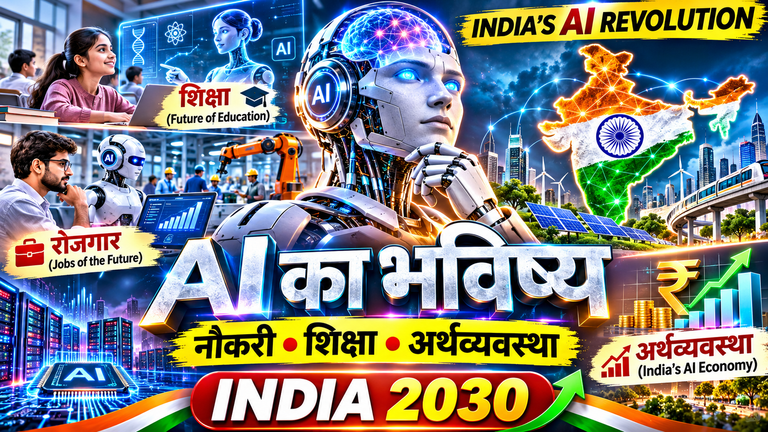
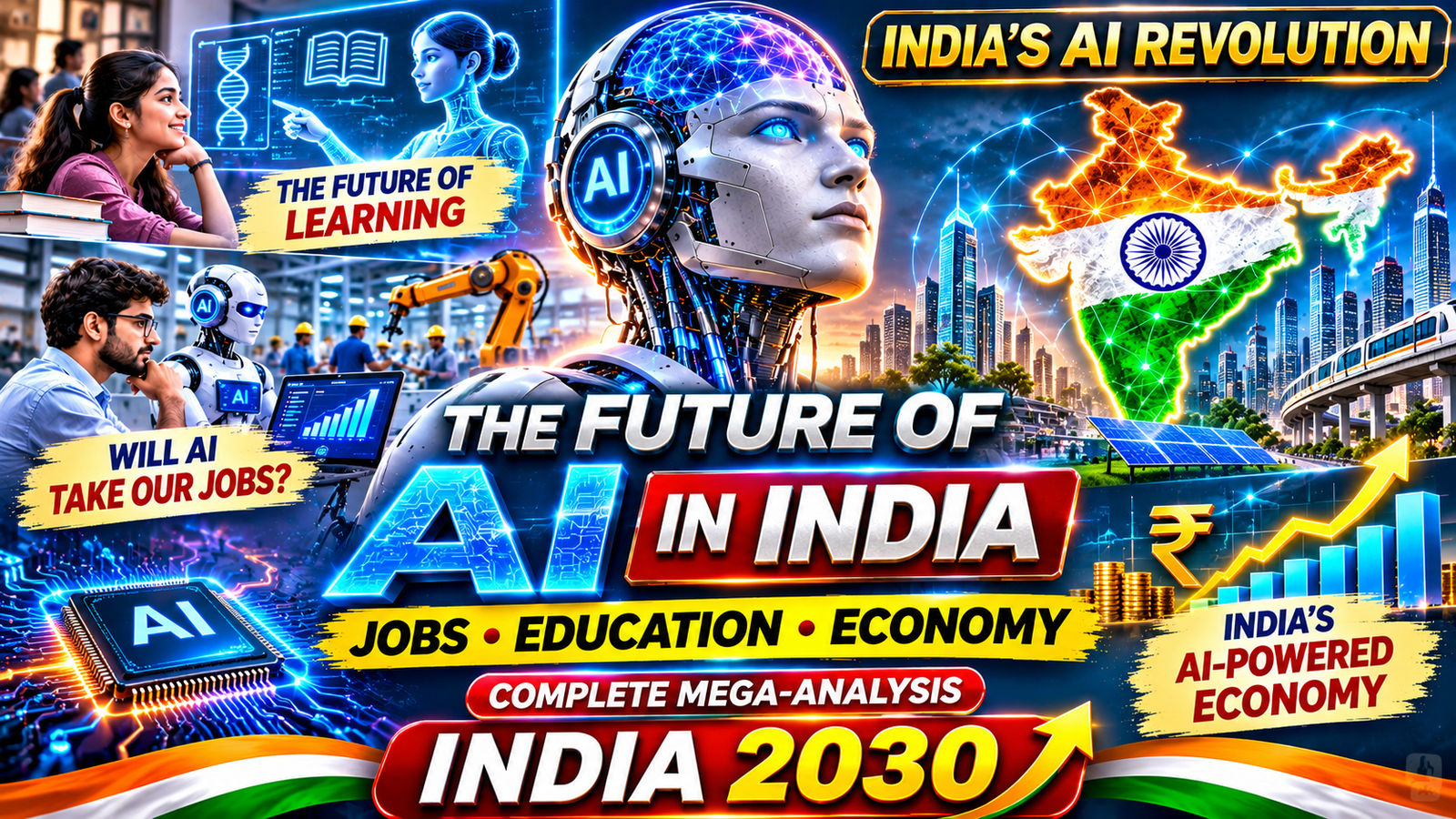

The Future of AI in India: Impact on Employment, Education, and Economy (A Complete Mega-Analysis)
Will machines replace humans? Will our future be in the hands of robots? Or is this a magic wand that will free India from poverty, unemployment, and illiteracy, turning it into a developed nation? Let’s dive deep into this mysterious and exciting world of Artificial Intelligence (AI)…
Imagine a student sitting in a remote village of Bihar, who only speaks Bhojpuri, learning from the world’s best science teacher in his mother tongue. On the other hand, a farmer in Punjab is looking at accurate data on weather, soil moisture, and market prices on his smartphone to decide when to sell his crop. This is not a scene from a Sci-Fi movie; this is the emerging reality of today’s India thanks to Artificial Intelligence (AI).
When we missed the ‘Industrial Revolution’, we had to endure centuries of slavery and poverty. But today, the world stands on the brink of the Fourth Industrial Revolution (Industry 4.0), and India has the potential to be not just a spectator, but a major player in it. For candidates preparing for prestigious exams like UPSC and BPSC, ‘AI’ is not just a technical term; it is a burning issue linked to Good Governance, Economy, National Security, and Social Justice.
1. Impact on Employment: Job Loss or the Dawn of a New Era?
Whenever AI is discussed, the first fear that comes to a common man’s mind is — “Will I lose my job?” History is witness that in the 90s when computers arrived in India, there was a similar outcry that everyone would become unemployed. But what was the result? India became the world’s largest IT (Information Technology) hub. The story with AI is going to be somewhat similar, only the pace of change is much faster.
Challenges in Employment (Loss of Traditional & Routine Jobs)
There are no two ways about it that AI will rapidly swallow jobs that are ‘Repetitive’ and ‘Routine’ in nature.
- Affected Sectors: Data entry, basic customer care (Call Centers), clerk-level work, assembly line work, and even basic software coding (Entry-level coding) are at risk.
- According to the World Economic Forum’s (WEF) ‘Future of Jobs’ report, millions of jobs will be displaced worldwide due to AI and automation. In India, where a large population relies on BPO and IT services, this could be a warning bell if we don’t adapt in time.
Birth of New Opportunities (Creation of the New AI Economy)
Every sunset is followed by a new sunrise. AI will create many times more new and high-paying jobs than the old ones it destroys.
- Prompt Engineering: The art of extracting the best results by giving correct and precise instructions to AI (like ChatGPT or Gemini). This is going to be the most in-demand job of the future.
- AI Ethics Officer: To ensure that AI is fair, unbiased towards any caste or religion, and non-discriminatory. (Highly important from the perspective of the UPSC ‘Ethics’ paper).
- Data Annotators and Model Trainers: Millions of images and texts need to be labeled to train AI models. This is becoming a massive opportunity under the ‘Gig Economy’ for youth in India’s Tier-2 and Tier-3 cities (like Patna, Indore, Lucknow).
Conclusion on Employment: To reap its Demographic Dividend, India must ‘Re-skill’ and ‘Up-skill’ its vast young workforce. If we don’t wake up in time, this dividend could turn into a Demographic Disaster.
2. AI Mega-Revolution in Education: The Journey from Rote Learning to Real Understanding
The biggest criticism of the Indian education system has been its ‘One Size Fits All’ approach. There are 50 kids in a class, but everyone’s learning pace is different. AI can transform this entire system. The National Education Policy (NEP) 2020 also heavily emphasizes technological integration in education.
Personalized Learning
Imagine every student having their own personal ‘AI Tutor’. AI can analyze every student’s learning capacity, weaknesses, and pace. If a child doesn’t understand geometry in math, the AI tutor will explain it using different methods and 3D animations until the concept is absolutely clear.
Breaking Language Barriers
India is a land of diversity. The Government of India’s ‘Bhashini’ project is a brilliant example of overcoming language barriers. Real-time accurate translation is becoming possible with the help of AI. A professor or scientist from South India can teach in Tamil or English, and a student in Uttar Pradesh or Bihar can simultaneously hear and understand it in their mother tongue, Hindi or Bhojpuri. This will bring true Inclusive Growth in the education sector.
Teacher Empowerment
The question often arises: will AI eat up teachers’ jobs? The answer is – No! AI will not replace teachers; instead, it will become their super-assistant. AI can do tedious tasks like grading papers, taking attendance, creating progress reports, and making lesson plans in minutes. This will allow teachers to dedicate their valuable time to students’ Character Building, moral education, and nurturing Creativity.
3. Impact on the Economy: The $5 Trillion Dream and AI’s Booster Dose
If India wants to become a $5 Trillion economy and achieve the goal of ‘Viksit Bharat @2047’, AI is the powerful engine that will speed up this train. According to NASSCOM and McKinsey reports, AI could add up to $500 billion to India’s GDP in the coming decades. Let’s see how it’s working miracles in various sectors:
Agriculture – The New Wave of AgriTech
More than half of India’s population still relies directly or indirectly on agriculture. But our agriculture is monsoon-dependent and surrounded by outdated technologies. AI could prove to be a game-changer here:
- Precision Farming: With the help of satellite data and AI algorithms, farmers can now know exactly how much fertilizer or water is needed in which part of the field.
- Disease Prediction: By clicking a photo of the crop on an AI app, farmers can instantly know which pest has attacked the crop and which pesticide to spray.
- Kisan Drones: AI-powered drones can uniformly spray pesticides over an entire field in a few minutes, saving both time and cost.
Healthcare – ‘Sanjeevani’ Reaching Remote Villages
The doctor-patient ratio in India is very low; there is a severe shortage of good doctors, especially in rural areas.
- AI-equipped Predictive Analysis can detect diseases like cancer, TB, and diabetes in their early stages. AI is proving to be faster and more accurate than humans in reading X-Rays and MRI scans.
- Telemedicine and AI chatbots are becoming capable of providing 24/7 Primary Health Advice in remote areas.
FinTech and Smart Manufacturing
India’s UPI (Unified Payments Interface) is making waves worldwide. Fraud detection is being strengthened using AI. On the other hand, under ‘Make in India’, AI sensors alert factory owners before machines break down (Predictive Maintenance), saving crores of rupees in potential losses.
4. Use of AI in Good Governance and Administration
As a Civil Servant, understanding the use of AI in administration is paramount. How is the government utilizing it?
- Stopping Scheme Leakages: AI data mining is being used to identify fake beneficiaries in PDS (Public Distribution System) and MGNREGA, thereby curbing corruption.
- Crime Control (Predictive Policing): Criminals can be identified even in crowds via AI cameras (CCTV) and Facial Recognition. By analyzing crime patterns, police can know in advance which areas have a higher probability of crime.
- Grievance Redressal: Millions of complaints land on government portals (like CPGRAMS). AI can read these complaints and instantly route them to the relevant department, significantly reducing Red Tapism.
5. Challenges and Ethics – The Other, Scarier Side of the Coin
Looking only at the bright side of any technology is incomplete. AI brings with it some very serious and concerning challenges; moving forward without resolving them could be fatal for society:
- Data Privacy: AI machines are data-hungry. They are recording everything—our behavior, our likes, and dislikes. To ensure our personal data remains secure, the Government of India has passed the DPDP Act, 2023 (Digital Personal Data Protection Act).
- Deepfakes and Threat to Democracy: Using AI, highly realistic but entirely fake videos of any politician or individual can be created. During elections, this can influence Free & Fair Elections by setting a fake narrative.
- Digital Divide: There is still a massive gap in internet and smartphone access between rural and urban areas in India. Those with access to AI will surge ahead, and those without it will fall further behind. This will undoubtedly widen inequality.
- Algorithmic Bias: AI doesn’t think on its own; it learns from data provided by humans. If the data contains racism, religious prejudice, or Sexism, AI will make similarly discriminatory decisions when recruiting or approving loans.
Government Initiatives & Way Forward
The Government of India is very serious about AI. NITI Aayog has presented a national strategy of “AI for All”. India’s AIRAWAT (AI Research, Analytics and Knowledge Assimilation platform) supercomputing infrastructure is a massive step towards indigenous AI development. Recently, the Indian government also approved the ‘IndiaAI Mission’, under which massive funding is being provided for computing capacity and AI startups in the country.
Conclusion
The future of AI in India is neither purely a Utopia nor a Dystopia. It is a powerful double-edged sword. If we provide modern Education to our youth, establish strict Ethical Frameworks for technology use, and develop indigenous AI models (like Krutrim AI, BharatGPT) instead of relying solely on Western countries, then AI can play the biggest role in making India a ‘Vishwa Guru’ in the 21st century.
Ultimately, the future will not belong to those who invent AI, but to those who use it with the utmost wisdom and compassion for the welfare of all humanity.