
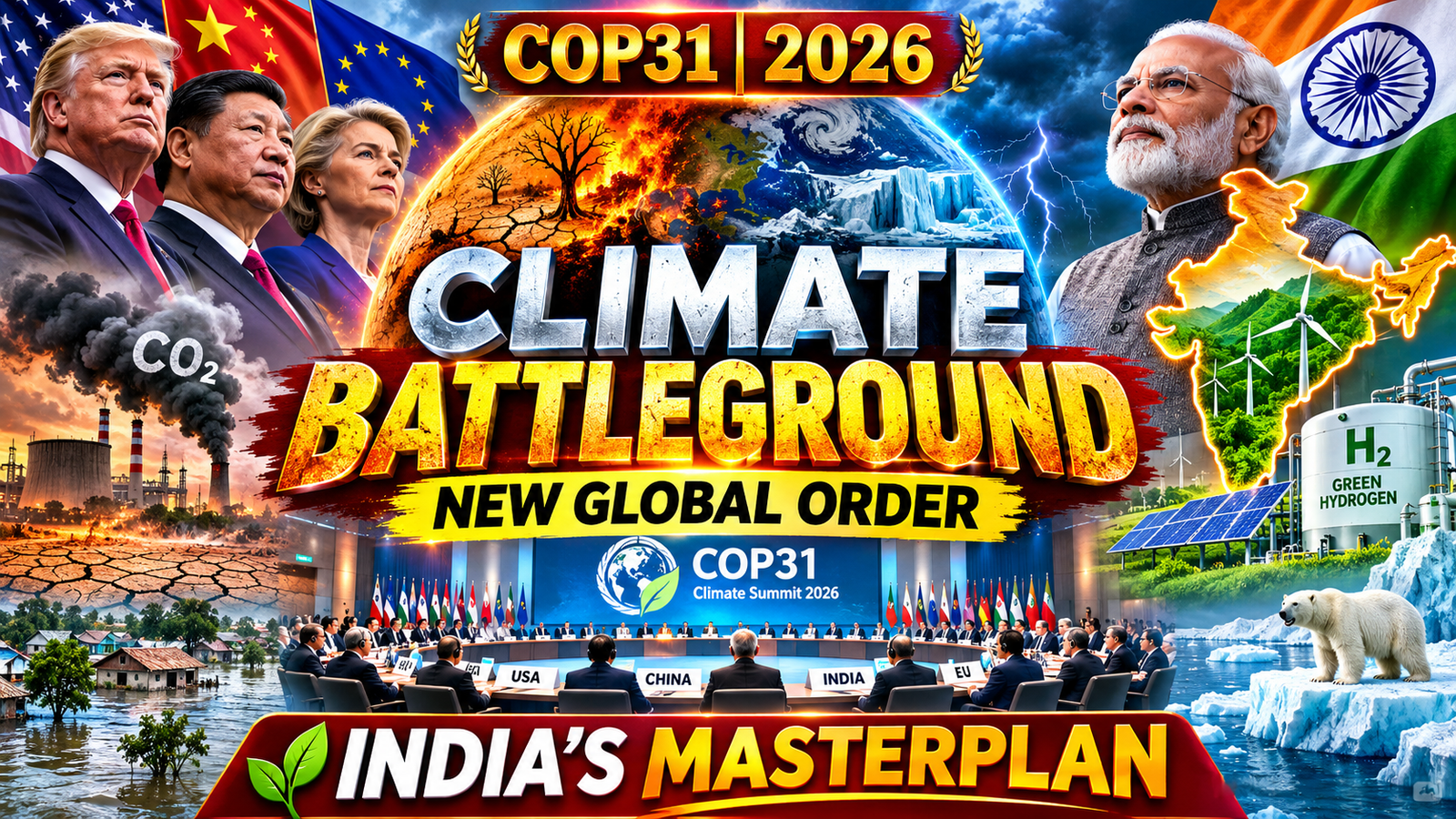

COP31 (2026): The Climate Battleground, New Global Order, and India’s Strategic Masterplan
– António Guterres (Secretary-General, United Nations).
This is not mere diplomatic rhetoric; it is the death knell for human existence as we know it. The upcoming COP31 in 2026 will not just be a gathering of environmentalists, but the largest geopolitical and economic battlefield of the 21st century.
If you are an aspirant preparing for top-tier examinations like UPSC (Civil Services), BPSC, or UPPCS, you must thoroughly understand that ‘Environment & Ecology’ is no longer merely a sub-topic of biology. Today, it is the central pivot around which the entire global economy, international trade, and foreign policy revolve. Melting Himalayan glaciers, 52°C blistering heat in Delhi, intensifying cyclones in the Arabian Sea, and sinking islands in the Pacific—these are glaring proofs that our ecosystem is teetering on the brink of collapse.
Amidst this unprecedented mega-crisis, the world’s last hopes rest on the UNFCCC (United Nations Framework Convention on Climate Change) summits. After the promises of Paris (COP21), the disappointments of Glasgow (COP26), and the partial agreements of Dubai (COP28), the proposed COP31 in 2026 is a ‘Make or Break’ summit. In this highly detailed article, we will not only discuss surface-level diplomacy but dive deep into the maximum depths of GS Paper 3 (Mains)—analyzing climate finance mechanisms, new carbon markets, the war for critical minerals, and India’s strategic moves as the undisputed leader of the ‘Global South’.
1. Historical Evolution of Climate Diplomacy
Before understanding the Kurukshetra of 2026, we must understand the history of this war. COP (Conference of the Parties) did not emerge overnight. It is the result of decades of deep-rooted mistrust between developed and developing nations:
- 1992 – Rio Earth Summit: This birthed the UNFCCC. For the first time, the world officially acknowledged that climate change is anthropogenic (human-induced). The fundamental principle of CBDR (Common But Differentiated Responsibilities) was born here.
- 1997 – Kyoto Protocol (COP3): For the first time, legally binding carbon emission reduction targets were imposed on developed nations. However, due to the exit of major emitters like the US, it largely failed in its overarching objectives.
- 2015 – Paris Agreement (COP21 – The Historic Turning Point): This was a diplomatic masterstroke. Instead of binding targets, a Bottom-up Approach was adopted, where each country announced its voluntary targets (NDCs – Nationally Determined Contributions). The goal was set: Limit global temperature rise to well below 2°C, preferably to 1.5°C, compared to pre-industrial levels.
- 2021 to 2025 (The Transition Period): At Glasgow (COP26), India delivered the ‘Panchamrit’ and the world agreed to “phase down coal”. Sharm el-Sheikh (COP27) saw the historic victory of the Loss & Damage Fund. In Dubai (COP28), the world officially acknowledged “transitioning away from fossil fuels” for the first time. In 2025 (COP30, Brazil), all nations will submit their new NDCs, the implementation of which will fiercely begin from COP31 in 2026.
2. COP31 (2026): Why is this Summit a ‘Game Changer’?
COP31 will likely be co-hosted by Australia and the Pacific Island Nations (like Tuvalu, Fiji, Samoa). From a geopolitical perspective, this in itself is a massive statement.
These Pacific nations do not call themselves small islands; they refer to themselves as ‘Large Ocean States’. For them, climate change is not future economics; it is a present-day existential threat. A rise of mere centimeters in Sea Level could wipe their entire geography off the world map. When these nations sit at the COP31 table, the world will witness the sharpest clash against the hollow promises of developed countries, trillions of dollars in climate finance, and human rights.
3. Key Battlegrounds for COP31 (UPSC Mains Focus)
Competitive exam aspirants must look beyond superficial news and dissect these technical and economic issues. The fiercest debates at the COP31 table will revolve around the following:
A. New Collective Quantified Goal (NCQG)
In 2009 (Copenhagen), developed nations promised to provide $100 Billion annually in climate finance to developing countries by 2020. This promise proved to be a colossal failure. The biggest mandate for COP31 is to finalize a new financial framework (NCQG) for the post-2025 period.
What is the dispute? India, the African Union (AU), and the ‘Global South’ are categorically stating that ‘billions’ will no longer suffice; the world needs Trillions of dollars. According to India’s Economic Survey, India alone requires $2.5 trillion by 2030 to meet its climate goals. The debate will be about where this money will come from: A Global Wealth Tax, a Windfall Tax on fossil fuel companies, or structural reforms in the World Bank/IMF (MDBs)?
B. The ‘Bridgetown Initiative’ and MDB Reforms
This is a highly burning topic. Initiated by Barbados Prime Minister Mia Mottley, this initiative demands massive structural changes in the lending systems of the World Bank and International Monetary Fund (IMF). When poor countries face climate disasters, they should be granted Debt Pause Clauses and must receive funding for climate projects at extremely concessional rates. Reforming the Global Financial Architecture will be a centerpiece at COP31.
C. Carbon Border Adjustment Mechanism (CBAM) – The New Trade War
This is a ‘Hot Topic’ for UPSC Economy and Environment. The European Union (EU) has implemented a ‘green tax’ called CBAM. If countries like India, China, or Brazil export carbon-intensive products such as steel, cement, aluminum, or fertilizers to Europe, the EU will impose a heavy import duty on them.
The COP31 Uproar: India and the BASIC countries (Brazil, South Africa, India, China) have termed this ‘Green Protectionism’. India will argue that developed nations industrialized by burning cheap coal for centuries, and now, when developing countries are industrializing, the West is erecting Trade Barriers in the name of climate. This is a direct violation of WTO rules and the sacred principle of CBDR.
D. The New Geopolitics of Critical Minerals
Moving away from the era of coal and oil, the world is shifting towards Electric Vehicles (EVs), solar panels, and wind turbines. However, manufacturing these requires Lithium, Cobalt, Nickel, and Rare Earth Elements (REEs). Currently, China holds a near-monopoly over the mining and refining of these minerals. COP31 will fiercely debate how the world can rely on a single country (China) for energy security under the guise of a ‘green transition’. How do we build secure, equitable, and environmentally friendly supply chains?
E. Global Carbon Markets and Article 6 of the Paris Agreement
Article 6 of the Paris Agreement allows countries to trade Carbon Credits. Suppose a company in India sequesters 1000 tons of carbon through afforestation. It earns credits, which it can sell to an American company unable to reduce its emissions. At COP31, the focus will be on making the rulebook of this market incredibly strict and transparent to completely eradicate ‘Double Counting’ and ‘Greenwashing’ (the deceptive practice of appearing environmentally friendly).
F. Operationalizing the Loss and Damage Fund
The fund established during COP27 and COP28 will become fully operational by COP31. But the million-dollar question remains: Who will fill the coffers? Will the US (historically the largest emitter) take legal responsibility? Will China (currently the world’s largest emitter) contribute? Developing nations fear that routing this fund through the World Bank might turn it into a new Debt Trap. It must be provided as Grants, not as Loans.
4. India’s Strategic Masterplan and Leadership of the ‘Global South’
India is no longer a defensive player on the global climate stage; it has emerged as an aggressive ‘Agenda Setter’. Following its highly successful G20 presidency, India’s strategy at COP31 will be to forcefully amplify the voice of the Global South (developing and least developed countries):
- Just Energy Transition: Western countries will exert immense pressure for an immediate “Phase Out” of coal. India will counter strongly: “India’s per capita carbon emission is less than one-third of the global average.” The energy security of our vast population depends on coal. We will ‘Phase Down’ coal, but this transition must be Just and Equitable so that millions of poor workers are not left unemployed.
- Showcasing Domestic Triumphs: India will present its stellar report card to the world. India is rapidly advancing towards its 2030 target (500 GW of non-fossil capacity). Initiatives like Sovereign Green Bonds, the PAT (Perform, Achieve and Trade) scheme for energy efficiency, and the National Green Hydrogen Mission are the ultimate weapons in India’s climate arsenal.
- Mission LiFE (Lifestyle for Environment): India will offer a profound philosophy: Technology alone cannot save the planet. The West’s mindless capitalistic mentality of ‘Use and Throw’ (Mindless Consumption) must be overhauled. India will pitch its ‘Green Credit Program’ (GCP) as a replicable global model.
- Global Institution Building: Through the International Solar Alliance (ISA), Coalition for Disaster Resilient Infrastructure (CDRI), and the Global Biofuel Alliance (GBA), India will present itself not as part of the problem, but as the ultimate ‘Solution Provider’ to the world.
5. The Way Forward: Solutions for a Burning Planet
If humanity is to step back from this precipice, COP31 must not merely produce a document of promises; it must formulate a concrete Blueprint for Action:
1. Democratization of Climate Finance: The ‘Blended Finance’ model must be aggressively adopted, where public funds are utilized to de-risk private sector investments in developing nations.
2. Technology Transfer (Without IPR Barriers): Developed countries must free critical green technologies (like Carbon Capture & Storage – CCS, Solid-State Batteries) from the rigid shackles of Intellectual Property Rights (Patents/IPR) and transfer them to developing countries at affordable rates.
3. Nature-based Solutions (NbS): Machines alone cannot absorb all the carbon. The conservation of the Amazon rainforests, India’s mangrove forests (MISHTI scheme), coral reefs, and wetlands (Ramsar sites) must be placed at the absolute core of climate strategy.
4. Climate Adaptation in Agriculture: A massive portion of global greenhouse emissions comes from agriculture (methane and nitrous oxide). COP31 must officially recognize ‘Climate-Smart Agriculture’ and Millets (Shree Anna) as vital pillars for global food security and climate solutions.
Conclusion
“Nature does not know how to forgive; it only settles the score.” The COP31 summit in 2026 is no ordinary bureaucratic gathering; it is the ultimate diplomatic effort to squeeze through the rapidly ‘Closing Window of Opportunity’. If developed nations continue to evade their ‘Historical Responsibility’ while dictating policies to the developing world, we will inevitably march toward a dystopia teeming with hundreds of millions of ‘Climate Refugees’, rendering geopolitical boundaries utterly meaningless. The final salvation for this boiling planet lies embedded in the ancient Indian ethos: ‘One Earth, One Family, One Future’.
Highly Important FAQs for UPSC/BPSC Mains Examination
1. What is the principle of ‘CBDR-RC’ under UNFCCC, and why is it India’s primary diplomatic weapon?
CBDR-RC (Common But Differentiated Responsibilities and Respective Capabilities) means that while fighting climate change is a ‘common responsibility’ for all nations, the burden of reducing it is ‘differentiated’. Developed nations (US, EU) have indiscriminately emitted massive amounts of carbon during their centuries of industrialization (Historical Emissions). Therefore, the primary responsibility to drastically cut emissions and provide finance and technology to developing nations lies with them. India uses this principle as an impenetrable shield against unfair pressures from developed nations (such as demands for an immediate halt to coal usage).
2. What is the ‘Bridgetown Initiative’, and why will it be crucial at COP31?
It is a master plan proposed by Barbados to fundamentally reform the global financial system (World Bank, IMF). Its core objective is to ensure that when poor or developing nations are struck by climate disasters (hurricanes, floods), they are granted temporary suspension of their old debt repayments and are provided trillions of dollars in climate finance at highly concessional rates rather than exorbitant commercial interest rates. The framework for climate finance at COP31 will revolve heavily around this initiative.
3. What is ‘CBAM’ (Carbon Border Adjustment Mechanism), and why is it labeled ‘Protectionism’?
CBAM is a carbon tax introduced by the European Union (EU). Under this mechanism, if a country (like India) exports high-carbon products (such as steel, aluminum, or fertilizers) to Europe, the EU will levy a hefty tax at its borders. India, China, and South Africa fiercely condemn this as ‘Green Protectionism’ because it stifles the trade of developing nations and directly violates World Trade Organization (WTO) rules on free trade as well as the Paris Agreement’s CBDR principle.
4. What is the technical difference between ‘Net-Zero’ and ‘Carbon Neutrality’?
Although frequently used interchangeably, technically: ‘Carbon Neutrality’ refers exclusively to balancing out Carbon Dioxide (CO2) emissions (meaning emitting only as much CO2 as is absorbed). Conversely, ‘Net-Zero’ is a much broader and more comprehensive term; it involves balancing the emissions of all greenhouse gases (including CO2, Methane, Nitrous Oxide, and Fluorinated gases) by removing equivalent amounts from the atmosphere to reach an absolute zero level. India has ambitiously targeted reaching Net-Zero by the year 2070.
5. What does ‘Just Transition’ signify in the socio-economic context of India?
For a vast, developing country like India, shifting overnight from fossil fuels (especially coal) to renewable energy (Solar/Wind) is practically impossible. The livelihoods of millions of Indians (particularly in states like Jharkhand, Chhattisgarh, and Odisha) are inextricably linked to coal mines and allied industries. A ‘Just Transition’ signifies an energy shift that is beneficial for the environment without being economically devastating for the poor, laborers, and regional economies. It mandates comprehensive reskilling of workers, rehabilitation, and the creation of alternative, green employment opportunities.
6. What is the ‘Global Stocktake’ (GST)?
It is the official Evaluation Mechanism of the Paris Agreement. Under this, the world’s collective climate action is comprehensively reviewed every 5 years. Think of it as a ‘Global Report Card’ that reveals exactly how close or far the world is from the 1.5°C threshold. The very first GST concluded in 2023 (COP28, Dubai), and based strictly on its findings, all nations are mandated to submit their new, highly ambitious NDCs (targets) by 2025 (COP30), which will be the central subject of intense brainstorming and implementation at COP31.