

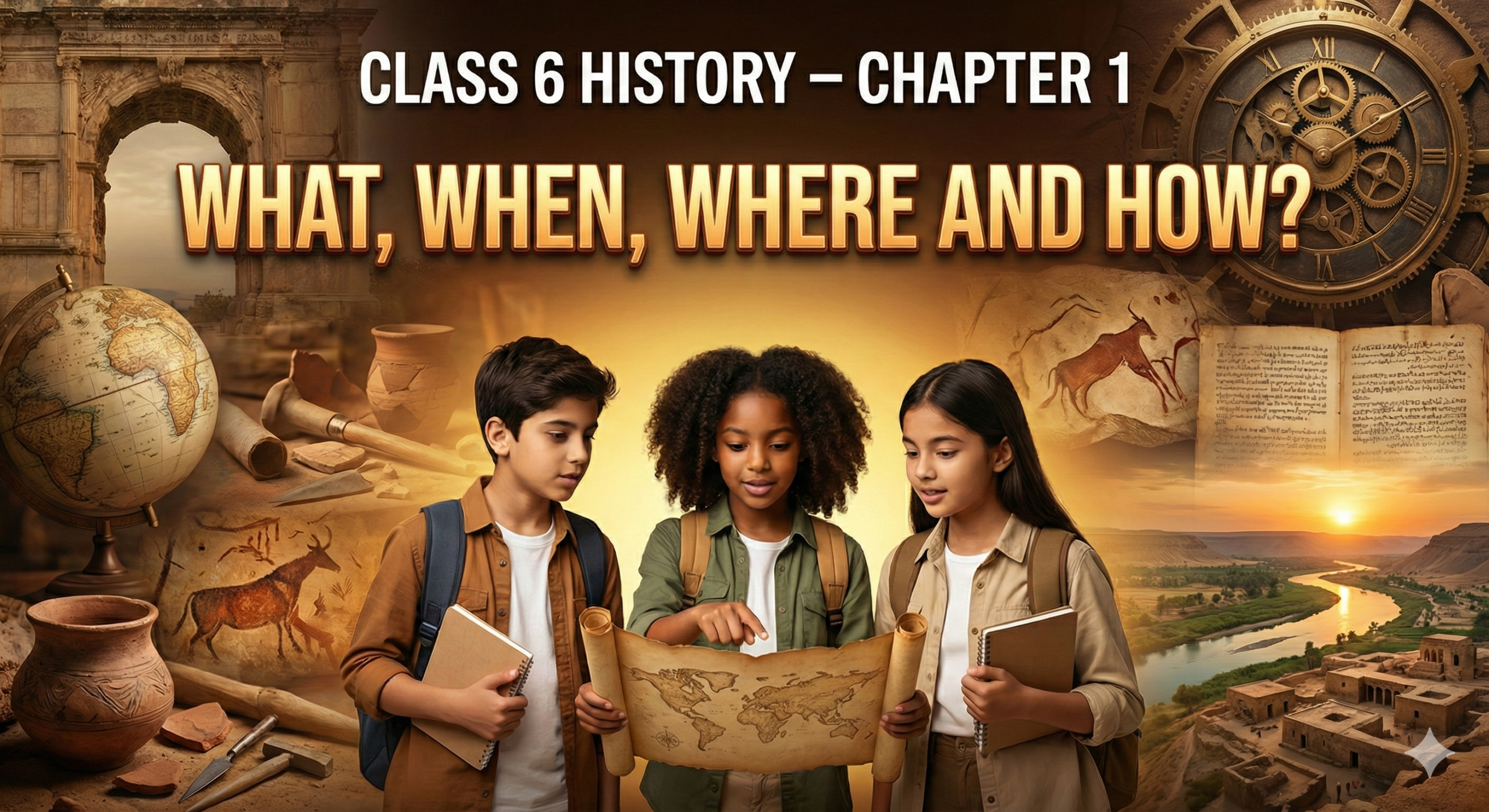

Class 6 History – Chapter 1: What, Where, How and When?
(Detailed UPSC/IAS Foundation Guide)
1. Chapter Introduction & Relevance for UPSC
Hello friends. Today, we will understand the foundations of history in depth. Chapter 1 of the Class 6 NCERT book “Our Pasts – I” is not just a lesson, but a perspective on how to view history. For UPSC, BPSC, and other State PCS exams, this chapter serves as a “Gateway” to understanding Ancient History.
Special Note for UPSC Aspirants:
In the Preliminary Examination (Prelims), direct questions arise from Geographical Locations (Map-based) and Ancient Terminology found in this chapter. For the Mains Examination, this chapter helps you understand how Indian culture and society evolved chronologically.
2. What is History?
History is often called the “study of the past,” but as a future administrator, you must view it differently. History is the study of ‘Change’ and ‘Continuity’.
- Social Evolution: It tells us how human society transformed from ‘Hunter-Gatherers’ to ‘Modern Citizens’.
- Past vs. Present: History helps us understand how our current languages, food habits, and customs evolved. For example, the tea we drink or the trains we travel in have a history of their own.
- Story of Common People: History is not just dates of wars and kings; it is a tool to understand the lifestyles of children, women, farmers, and merchants of that era.
3. What can we know about the past?
Through history, we can uncover every aspect of human life. We can categorize this into three main segments:
- Basic Needs:
- Food: Did people eat raw meat or cooked? Roots and fruits or grains? (e.g., Wheat and Barley in Sulaiman Hills).
- Clothing: Had they learned to grow Cotton, or did they wear animal skins and tree bark?
- Shelter: Did they live in Caves, Pit-houses, or houses made of baked bricks?
- Social Classes: We can learn about different professions – such as Hunters, Herders, Farmers, Rulers, Merchants, Priests, Craftspersons, and Artists.
- Cultural Life: What games children played, which lullabies they heard, and what plays they watched. This is part of ‘Cultural History’.
4. Where did people live? (Geographical Analysis)
There is a deep connection between History and Geography. Why did people always settle near rivers? Because rivers provided water, fish (food), and a mode of transport. Let’s understand the key locations on the map in detail:
(A) Narmada Valley (The Beginning of Life)
The Narmada Valley (Madhya Pradesh) holds some of the oldest evidence of human habitation in India.
- Millions of Years of History: People have lived here for several hundred thousand years. The Bhimbetka caves are proof of this.
- Skilled Gatherers: The people here were ‘Hunter-Gatherers’. They did not grow food but collected roots, fruits, and forest produce.
- Knowledge of Wealth: They knew which plants were poisonous and which were medicinal. This knowledge was passed down from generation to generation.
(B) Sulaiman and Kirthar Hills (Beginning of Agriculture)
This region is on the border of present-day Pakistan and Afghanistan. It was a ‘Transition Zone’.
- Neolithic Revolution: About 8000 years ago, men and women first began to grow crops here.
- Main Crops: Wheat and Barley. Note that Rice was not grown here.
- Animal Rearing: Instead of just hunting, they started rearing sheep, goats, and cattle, which provided both milk and meat.
- Settled Life: Agriculture forced people to stay in one place, leading to the formation of ‘Villages’. Mehrgarh is the most famous example of this.
(C) Garo and Vindhya Hills (The Rice Region)
Agriculture developed independently in the Garo Hills (North-East) and Vindhyas (Central India).
- North of the Vindhyas: This is the place where Rice was cultivated for the first time. This area is believed to be around Koldihwa (Allahabad/Prayagraj).
- This proves that agriculture in India did not develop in just one place, but in different places at different times.
(D) Indus and its Tributaries (First Urbanisation)
This is called the ‘First Urbanisation’.
- 4700 Years Ago: When many parts of the world were still primitive, cities with baked brick houses (like Harappa and Mohenjo-Daro) had flourished in the Indus Valley.
- These cities were famous for their drainage systems and trade.
(E) Ganga Valley and Magadha (Second Urbanisation)
Cities developed in the Ganga plains much later than the Indus Valley (about 2500 years ago).
- Rise of Magadha: Magadha (modern Bihar), located at the confluence of the Ganga and Son rivers, became the most powerful Mahajanapada.
- Reasons:
- Rivers made trade and transport easy.
- Fertile soil led to good harvests (more Tax revenue).
- Nearby forests (Jharkhand) provided elephants (for the army) and iron (for weapons).
7. Names of the Land: India and Bharat (Etymology)
The naming of our country is a great example of linguistic evolution.
- Journey of ‘India’:
Sanskrit: Sindhu → Iranian/Persian: Hindos → Greek: Indos → English: India.
Iranians and Greeks referred to the entire land to the East of the river Indus as ‘India’. - Journey of ‘Bharat’:
In the Rigveda (1500 BC), ‘Bharata’ was a group of people (tribe) living in the north-west. Gradually, the entire country came to be known as ‘Bharatvarsha’ or ‘Bharat’ after this tribe.
Sources of History (Detailed Analysis)
Historians and archaeologists work like detectives. They rely on three main sources:
(A) Manuscripts – Written Evidence
‘Manu’ (Latin for Hand) + ‘Script’ (Writing). These are hand-written books from the past.
- Creation: Books were made by cutting Palm leaves and tying them together, or writing on the prepared bark of the Birch tree (found in the Himalayas).
- Preservation: These were very fragile. Insects destroyed many, but many survived in temples and monasteries.
- Subject Variety: Science, medicine, religious beliefs, lives of kings, poems, and plays.
- Language:
- Sanskrit: Language of scholars and Brahmins.
- Prakrit: Language of the common people (Mahavira and Buddha preached in this).
- Tamil: Ancient literature of South India (Sangam literature).
(B) Inscriptions – Imperishable Evidence
Writings engraved on hard surfaces like stone or metal.
- Purpose:
- Royal Orders: Kings wanted people to read and obey their rules (e.g., Ashoka’s Dhamma).
- Prashasti (Praise): Description of the praise and achievements of kings (e.g., Samudragupta’s Prayag Prashasti).
- Donation Records: Details of land grants given to temples or Brahmins.
- Case Study – Ashoka’s Kandahar Inscription: This is about 2250 years old. It is Bilingual – written in Greek and Aramaic. This shows that both these languages were spoken/understood in Afghanistan at that time.
(C) Archaeology – Material Evidence
Archaeologists excavate history buried underground.
- Excavation: Digging up mounds.
- Stratigraphy: Generally, objects found deeper in the excavation are considered older than those found in upper layers.
- What is found? Tools, Weapons, Pots, Pans, Ornaments, Coins, and remains of buildings.
- Biological Remains: Bones of animals, birds, and fish tell us what people ate. Burnt wood or carbonized grains are crucial for Carbon Dating.
One Past or Many?
Have you ever wondered why your book is titled “Our Pasts” (Plural)? Why not “Our Past”?
- Respect for Diversity: Different groups of people had different histories in India.
- The history of people in the Andaman Islands (fishing, hunting) was completely different from those living in cities (dependent on food supply).
- The lives of kings (who kept records) were different from the lives of farmers (who did not keep records).
- Therefore, we do not study just one history, but ‘Many Pasts’.
Interdisciplinary Connection
Connecting the dots between subjects is essential for UPSC preparation.
- History + Geography: The Himalayas protected India from invasions from Central Asia, but the Khyber and Bolan passes allowed for trade and cultural exchange. History is incomplete without Geography.
- History + Political Science (Polity): The transition from ‘Janapada’ to ‘Mahajanapada’ and then to ‘Empire’ teaches us the process of State Formation.
- History + Economics: Surplus agriculture led to trade, trade led to coinage, and coins led to the rise of markets and cities.
11. Understanding Dates (Timeline & Chronology)
Time in history is calculated based on the birth of Jesus Christ. Consider this as the ‘Zero Point’.
| Term | Full Form | Meaning & Description |
|---|---|---|
| BC | Before Christ | Time before the birth of Christ. It counts backwards (e.g., 500 BC is older than 200 BC). |
| AD | Anno Domini | ‘In the year of the Lord’. Time after the birth of Christ. (e.g., 2023 AD). |
| CE | Common Era | The secular alternative to AD. This is widely used today. |
| BCE | Before Common Era | The secular alternative to BC. |
| BP | Before Present | Used in scientific dating (like Carbon dating). |
18. Practice Questions (MCQs – UPSC Foundation)
Q1: In which of the following places was Rice grown for the first time?
- (A) Sulaiman and Kirthar Hills
- (B) Garo Hills
- (C) North of the Vindhyas (Koldihwa)
- (D) Banks of the river Indus
Answer: (C) North of the Vindhyas
Q2: Consider the following statements regarding ‘Manuscripts’:
- They were usually written on palm leaves or the bark of the birch tree.
- They were written on hard surfaces like stone and metal.
Which of the above statements is/are true?
- (A) Only 1
- (B) Only 2
- (C) Both 1 and 2
- (D) Neither 1 nor 2
Answer: (A) Only 1 (Hard surfaces are for Inscriptions, not Manuscripts)
Q3: The word ‘India’ is derived from which river?
- (A) Ganga
- (B) Indus (Sindhu)
- (C) Brahmaputra
- (D) Narmada
Answer: (B) Indus (Sindhu)
Q4: On the banks of which river did the Magadha Empire flourish?
- (A) Indus
- (B) Narmada
- (C) Ganga and Son
- (D) Kaveri
Answer: (C) Ganga and Son
Q5: Ashoka’s Kandahar Inscription was written in which two scripts?
- (A) Brahmi and Kharoshthi
- (B) Greek and Aramaic
- (C) Sanskrit and Tamil
- (D) Devanagari and Prakrit
Answer: (B) Greek and Aramaic
19. Mains Descriptive Questions
Q1: Why did ordinary men and women not keep records of what they did?
Answer Hint: At that time, ordinary people (hunters, gatherers, farmers, herders) were occupied with the daily struggle for survival and food. They likely did not know how to read or write. They did not have the resources (money) to commission inscriptions like kings, nor did they consider their daily achievements significant enough to be carved in stone. Hence, there are fewer written records of their lives.
Q2: How do archaeologists find out about the past? Explain the importance of sources.
Answer Hint: Archaeologists gain information from pots, tools, ornaments, bones, coins, and building remains found during excavations. These material evidences are ‘unbiased’. For instance, a King’s inscription might exaggerate the truth, but the remains of a common man’s hut or carbonized grains reveal the actual economic reality of that time.
20. Comprehensive Conclusion (Analytical Summary)
At the end of this chapter, as a Civil Services Aspirant, we must understand that history is not just a ‘collection of facts’ but an ‘analysis of human evolution’. The comprehensive conclusion of this chapter is based on 4 main pillars:
- 1. Geographical Context: We observed that early civilizations did not spring up at random places but due to specific geographical reasons. Food availability in Narmada taught ‘Gathering’, fertile Sulaiman hills taught ‘Agriculture’, and the vastness of the Indus gave birth to ‘Urbanisation’. Geography sets the stage for History.
- 2. Balance of Sources: To know history, one source is not enough. While Manuscripts give us ‘soft data’ on religious and social beliefs, Inscriptions and Archaeology (coins, tools) provide ‘hard data’ on political expansion and economic status. An unbiased historian constructs the truth by combining all these.
- 3. Plurality of Pasts: The NCERT title “Our Pasts” (Plural) reminds us that Indian history is not Monolithic. The history of a tribal in Andaman, a farmer in Magadha, and a King in Hastinapura ran on different tracks. Understanding this diversity of Indian society is key to administration.
- 4. Understanding Chronology: By taking the birth of Jesus Christ as the center (BC/AD), we learned a global language of time, which enables us to compare Indian events with World History (like Mesopotamia or Egypt).
Final Thought: This chapter is the foundation upon which the entire structure of Ancient India stands. To understand the Indus Valley Civilization, the Vedic Age, and the Mahajanapadas, this framework of ‘What, Where, How and When’ should always be in your mind.
21. Key Takeaways for Exam
- 8000 Years Ago: Beginning of Agriculture (Wheat/Barley) – Sulaiman and Kirthar (Pakistan).
- Evidence of Rice: North of the Vindhyas (Koldihwa/Allahabad).
- 4700 Years Ago: First Cities on the banks of Indus (Harappan Civilization).
- 2500 Years Ago: Second Urbanisation in Ganga Valley and the Magadha Empire.
- Manuscript: Palm leaf/Birch bark (Soft/Perishable).
- Inscription: Stone/Metal (Hard/Durable).
- India: Derived from Indus (Sindhu).
- Bharat: Named after a group of people (tribe) mentioned in the Rigveda.
© UPSC History Education Blog – Keep Learning!

Helpful content